
How Mamdani’s Instagram overturned a 20-point Cuomo lead
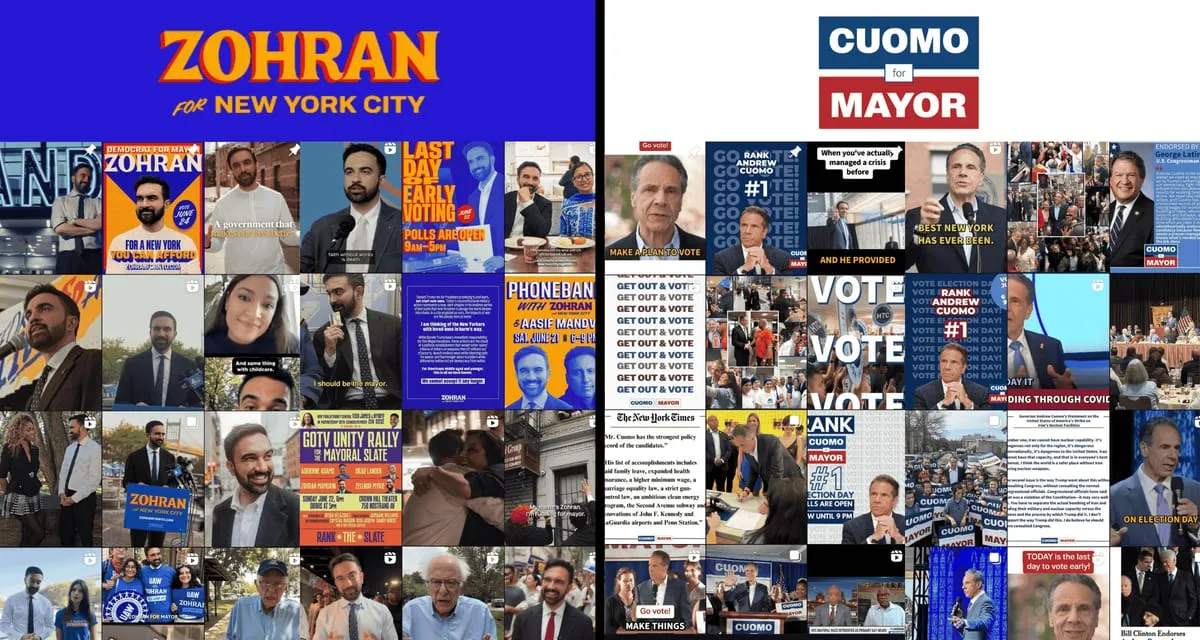
Zohran Mamdani overturned Andrew Cuomo’s 20-30 point lead in New York City’s 2025 Democratic mayoral primary with a campaign built for the feed, not the TV studio. Ben Guerin, co-founder of Topham Guerin, compares the two candidates’ Instagram grids and picks out four tactics, from one timely message on affordability to video posted within 60 minutes of every event.
- Published in
- bjhguerin.com
- By
- Ben Guerin
- Published
- 27 June 2025
- Type
- Opinion
- Topics
-
- digital campaigning
- political social media
- campaign strategy
What we argued
- In March, Cuomo led the Democratic primary by 20-30 points, with name recognition and establishment backing
- Cuomo’s Instagram was mostly TV clips and press screenshots; Mamdani’s was made for the platform, with a consistent warm filter
- Mamdani ran on one timely message, affordability: rent freezes, free buses and universal childcare
- A distinctive taxi-yellow brand, street conversations instead of podium events, and video posted within 60 minutes of each visit
- Establishment advantages count for less when voters get their news on their phones
In March, if you'd told anyone that Zohran Mamdani would beat Andrew Cuomo in the race for New York City mayor, they'd have laughed you out of the room.
Cuomo was leading by 20-30 points in the Democratic primary. He had name recognition, establishment backing, and the kind of political machinery that's supposed to guarantee victory in a city like New York. Mamdani was a relatively unknown state assemblyman with a fraction of the resources.
Yet on Tuesday, Mamdani picked up the Democratic nomination.
What happened? A masterclass in digital-first campaigning that should be required viewing for every aspiring politician, particularly those trying to unseat establishment candidates.
Just look at the Instagram grids
Sometimes the story is right there in the visuals. Look at the Instagram feeds of both candidates during the final weeks of the campaign, and you'll see two completely different approaches to politics – and two very different understandings of how voters make decisions in 2025.
While Cuomo was shouting at his audience to "VOTE, VOTE, VOTE," Mamdani was smiling and chatting with a diverse mix of New Yorkers. Where most of Cuomo's feed was filled with clips from TV appearances or screenshots of media articles, Mamdani's feed was entirely content produced specifically for that platform.
If you look closely at Mamdani's photos and videos, you'll notice something else: he's using a consistent filter that makes him look warm and positive, almost Wes Anderson-esque. It's a small detail that creates a massive cumulative effect.
Tactics that made a difference
Local political analysts with far more context and knowledge than I have already written plenty about the political machinations and demographic trends at play, so I'm not going to attempt to get into that here.
That said - at Topham Guerin, we've worked on more than 25 election campaigns around the world in the last decade, and having faced similar challenges as Mamdani and his team plenty of times before, there were four things that really stood out to me as key to his success.
A unifying and timely message
While Cuomo concentrated on crime – always a safe bet for establishment Democrats – Mamdani focused on something more fundamental: affordability. He called for rent freezes, free buses, and universal childcare.
In a city where housing costs dominate every conversation, this wasn't just good politics. It was smart positioning. Crime matters, but rent is what keeps people awake at night. Mamdani understood which issue would actually drive turnout.
A distinctive brand unlike any other
Inspired by the color of the iconic New York taxi, Mamdani's branding was immediately recognizable and distinctly New York. It stood out sharply against Cuomo's classic American red, white, and blue logo.
This matters more than most campaigns realize. In a world of infinite scroll, you have maybe half a second to register with someone before they move on. Distinctive branding isn't vanity – it's basic information processing.
Carefully curated visual moments
Mamdani shunned the traditional campaign event where politicians speak to voters from a podium. Instead, he chose to pound the pavement, talking to voters one-on-one and using that footage for his social content.
In a deeply Democratic city with diverse demographics, this positioned Mamdani as the "people's champion" and provided a stark contrast to an establishment politician with a controversial record.
Speed of digital execution
Here's the detail that impressed me most: Mamdani's digital team was turning content around so quickly that there would be a video posted within 60 minutes of each visit or event.
For anyone who has worked on a political campaign, you'll know just how insanely impressive that is. Most campaigns take days to get content approved, edited, and published. Mamdani's team was operating in real-time, capturing moments and getting them online while they were still fresh.
This speed created a sense of momentum and authenticity that you simply cannot manufacture in a traditional media strategy. When voters saw Mamdani's content, they were seeing something that had happened that morning, not last week.
Implications for campaigners
This will probably encourage a lot of copycat campaigns – especially on the left – around the world in the coming months. The aesthetics, policies, and specific tactics will have varying degrees of relevance outside of NYC, but the underlying principles are universal.
The traditional advantages of establishment candidates – name recognition, endorsements, media relationships – matter less when voters are consuming content on their phones rather than reading newspapers or watching television news.
What matters more is having a clear strategy, a deep understanding of digital platforms, and knowing how to tell a story in a creative and memorable way.
Mamdani's victory is part of a broader shift in how political campaigns work. We have moved away from broadcast-era tactics – the big speech, the TV ad, the newspaper endorsement – toward something more conversational and immediate.
This doesn't mean traditional media is dead. But it does mean that campaigns that understand how to combine both approaches – digital-native content with broader media strategy – will have a significant advantage over those that don't.
If you have a clear strategy, deep understanding of digital platforms, and know how to tell a story in a creative and memorable way, you can do almost anything. Even speed-run becoming mayor of one of the most important cities in the world.
The establishment is learning this lesson the hard way, one election at a time.
“Crime matters, but rent is what keeps people awake at night.”
Ben Guerin
“Distinctive branding isn’t vanity – it’s basic information processing.”
Ben Guerin
- 20-30 point lead Cuomo held in March
- 60 min from each visit or event to a posted video
- 25+ election campaigns Topham Guerin has worked on in the last decade
Questions & answers
How did Zohran Mamdani beat Andrew Cuomo?
Ben Guerin credits a digital-first campaign: one timely message on affordability, a distinctive brand, street-level footage instead of podium events, and content turned around so fast that video was posted within 60 minutes of each visit or event.
Why did Mamdani’s Instagram work better than Cuomo’s?
Cuomo’s feed was mostly clips from TV appearances and screenshots of media articles. Mamdani’s was made for the platform: conversations with a diverse mix of New Yorkers, shot with a consistent warm filter.
What can other campaigns learn from Mamdani?
The aesthetics and policies won’t travel everywhere, but the principles will: a clear strategy, a deep understanding of digital platforms, and a creative, memorable way of telling the story, combined with a broader media strategy.