Why your audience will simplify your message if you don’t
Boil your message down to something simple, or your audience will do it for you, and you may not like their version. That is the lesson Ben Guerin, co-founder of Topham Guerin, draws from the 2019 UK election and the COVID pandemic, in an interview with Tom Hashemi for the Policy Unstuck newsletter.
- Published in
- bjhguerin.com
- By
- Ben Guerin
- Published
- 22 January 2026
- Type
- Opinion
- Topics
-
- messaging
- political communication
- memes
- campaign strategy
What we argued
- Politics competes for attention with the Premier League and Netflix, so it has to be at least as entertaining
- Authenticity means refusing to mould yourself to the crowd, and being clear about why you are doing this at all
- A slogan is a heuristic, not a manifesto: people use it to file what they know about you
- A meme is a unit of information that spreads, and the best ones pack a lot of meaning into a word or two
- Speed wins: when leaders trust the campaign, it can repeat the same message until it finally cuts through
I was recently interviewed by Tom Hashemi for Policy Unstuck, a newsletter that's become essential reading for anyone working at the intersection of policy, advocacy and campaigns.
The core idea: your audience is never going to remember the footnotes, no matter how good they are. And they're going to have something to say about you whether you like it or not.
So the question becomes: do you want the one thing they say and remember to be what you want it to be, or what they want it to be?
It's a lesson we learned over and over during the 2019 UK election, and again during the COVID pandemic. And it applies far beyond politics.
The reality of public engagement in the attention economy
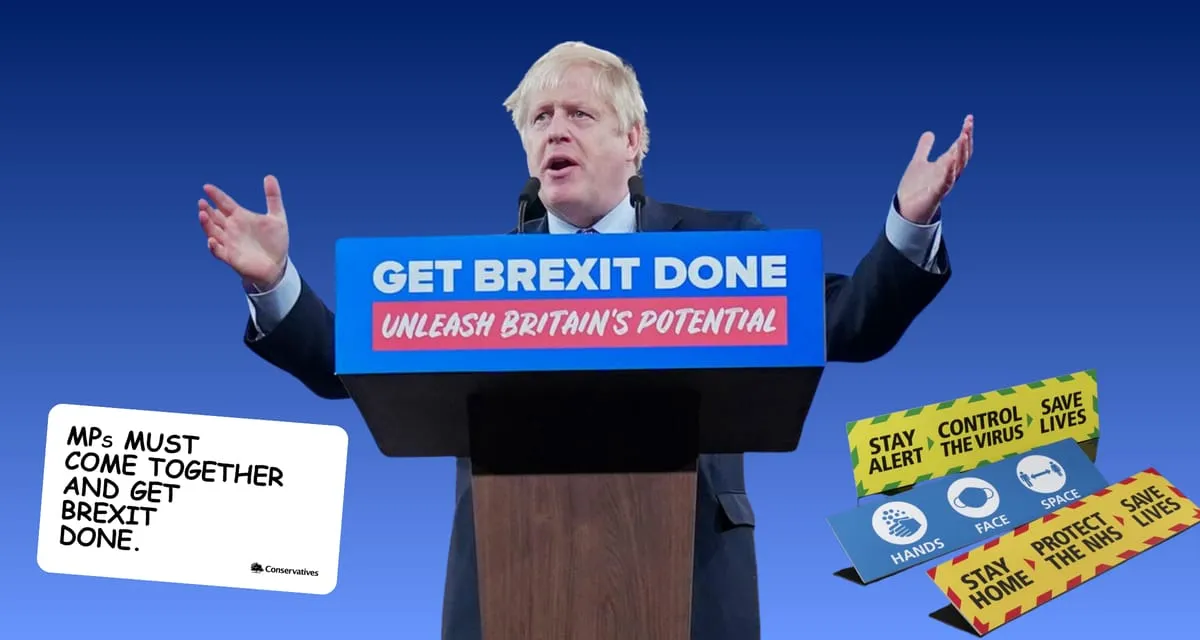
Boris Johnson understands that politics isn’t just about a battle of ideas. It’s also a battle of wits. And he knows that politics competes for people’s attention. You’re competing with the Premier League. You’re competing with whatever’s on Netflix… you’ve got to be at least as entertaining.
Everyone knows that zip wire thing or that rugby tackle. He was willing to look silly to compete for that attention, in complete contrast to most politicians who are terrified of looking undignified.
Authenticity means refusing to mould to crowds
Everybody knows that a large part of success in communications comes down to being authentic, but the problem is everyone says you’ve got to be authentic and it ends up meaning nothing.
Being authentic means having the kahunas to not do what everyone else is doing. Most people don’t act authentically in their normal behaviours. They mould to adjust and adapt to the crowd.
The question for any aspiring politician is ‘why did you bother getting into this in the first place?’
It’s a crap job. Everyone hates you, especially if you win. The pay is garbage unless you really make it to the top and then go work for OpenAI and pull an Osborne. So you’re not really in this for the money. The UK is not like one of these tinpot dictatorships where politicians live like kings, at least for now anyway.
So there’s genuinely some reason why you’ve gone into politics. Don’t be ashamed to tell people what that is.
If you can’t distill your argument down to a slogan…
Your audience is never going to remember the footnotes no matter how good they are. And the audience is going to have something to say about you, whether you like it or not. The question is do you want the one thing that they say and remember to be what you want it to be, or what they want it to be?
If you can condense your message down into something really simple and clear that makes sense to people, they’ll use it. So, you may as well work it out and give it to them.
Also, it’s a slogan. It’s not a manifesto. It’s a heuristic, right? It’s a thing that people use to label the information they store about you in their brain. You’ve got to lose stuff to get down to that lowest common denominator.
Memes are information units, not just images
Forget the idea of a meme as an internet picture with words on it; a meme is a unit of information that can spread across a network.
Memes are powerful because they compress all these heuristics about how people think and views they hold into a single word or group of words. It’s why Boris is so interesting because when you say ‘Boris,’ your brain immediately conjures up this disheveled, charismatic politician who’s not like all the others, and he’s posh but he doesn't act like it.
That word evokes so much emotion and so much interesting context, and that’s what gives it meme potential because you've got all this information encoded in a single word.
When you’re thinking about meme potential, you should be thinking about how much implicit knowledge is attached to whatever phrase or word you are using.
Hyper-targeting general public content is over-hyped
So much of the value of content that you produce is the social potential of it.
If you and I live in completely different social feed universes and see completely different things because of that, we aren’t going to have much to talk about. But the chances are that we probably see a lot of the same stuff from a lot of the same people and that gives us things to geek out about together.
So from a social content perspective, you don’t actually want everything to be hyper-targeted. You want people to be able to share that experience and talk about it.
The other thing is that you’re paying a premium for the sniper rifle compared to the shotgun, right? The way that data targeting works is the more layers you add on, the more expensive it’s going to be. So the question is: is that premium justified, especially given the social component to behaviour change that we’ve just talked about?
Delegate campaign decision-making to win
It doesn’t matter how good you are as a leader, if you’re spending your time signing off tweets, then you’re creating a bottleneck that’s going to slow a campaign down.
Boris trusted the campaign machine, and the campaign machine trusted us. That meant we could operate at crazy speed, I think on some days we were doing 20 Facebook posts a day.
When you can work quickly, you can do a lot. We often describe our political campaign approach as water dripping on a stone. You've got to say the same thing again and again and again until you wear down your audience. Only then are you finally starting to cut through, because quite frankly no one gives a damn, you have to make them.
“If you can condense your message down into something really simple and clear that makes sense to people, they’ll use it. So, you may as well work it out and give it to them.”
Ben Guerin
“Forget the idea of a meme as an internet picture with words on it; a meme is a unit of information that can spread across a network.”
Ben Guerin
- 20 Facebook posts a day on some days of the 2019 campaign
Questions & answers
Why should you simplify your message?
Because your audience will never remember the footnotes, and they will sum you up either way. If you give them something simple and clear, they will use your version instead of inventing their own.
What is a meme, really?
A unit of information that can spread across a network. Memes are powerful because they compress a lot of meaning into a single word or phrase.
Is hyper-targeting always worth it?
Not for general public content. Much of its value comes from people seeing and talking about the same things, and every extra targeting layer costs more.