At Davos, the AI winners weren’t the ones with the best models
The companies that will shape AI over the next year are the ones with political capital, not necessarily the best models. That is Ben Guerin’s read of Topham Guerin’s own Davos 2026 media analysis with data partner Omniscan, which tracked 30,020 articles to see who commanded the attention of regulators, investors and heads of state.
- Published in
- bjhguerin.com
- By
- Ben Guerin
- Published
- 12 February 2026
- Type
- Opinion
- Topics
-
- artificial intelligence
- media analysis
- reputation
What we argued
- Topham Guerin and data partner Omniscan analysed 30,020 articles from 1,346 publications, extracting 319,000 attributed quotes
- The Musk empire led on coverage (443 articles), then JPMorgan (238), BlackRock (224) and NVIDIA (224)
- OpenAI ranked ninth (74 articles), with the worst sentiment of any major AI player
- Jensen Huang drew 1,799 quotes at 97% positive sentiment; Anthropic outperformed OpenAI on volume and tone
Every January, around 3,000 of the world's most powerful people descend on a Swiss ski town for a week of panels, dinners, and what I'm told is very good fondue. The World Economic Forum at Davos is easy to dismiss as an elite echo chamber, but the media coverage it generates, who gets quoted, how often, and in what tone, is one of the most honest readouts available of where power is actually moving.
This year, my agency Topham Guerin tracked that coverage with our data partner Omniscan. We analysed 30,020 articles from 1,346 publications, extracting 319,000 attributed quotes across the week. The aim was to map the people and companies that commanded elite attention and how that attention was framed.
The results look nothing like the AI leaderboard most people carry in their heads.
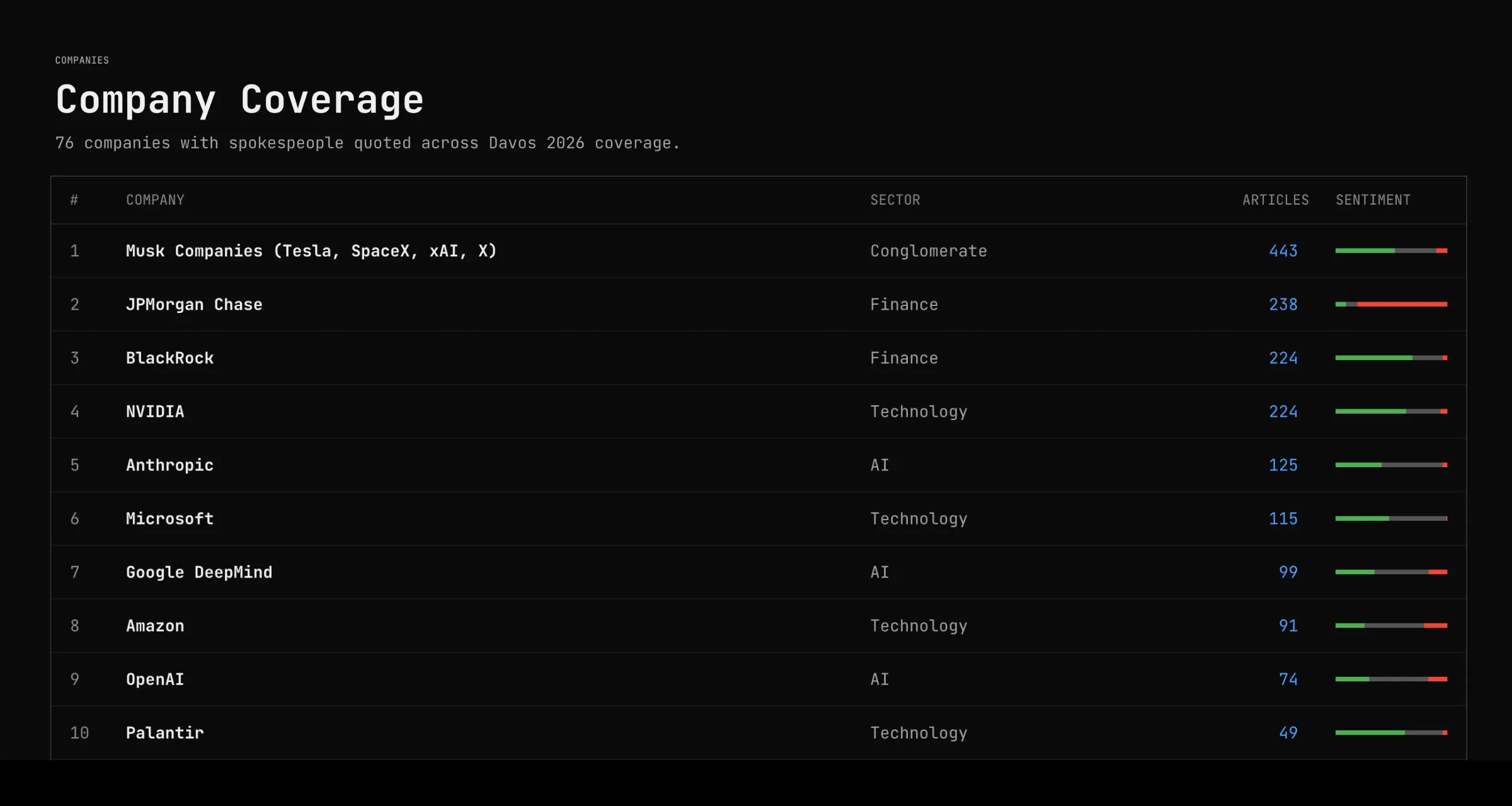
AI and its enablers dominated the top ten companies by coverage volume. But the composition was surprising. The Musk empire (Tesla, SpaceX, X and xAI, treated as one entity for reporting purposes) came first with 443 articles quoting Elon Musk. Then JPMorgan Chase (238) and BlackRock (224). Then NVIDIA (224). Then Anthropic (125), Microsoft (115), Google DeepMind (99), Amazon (91).
OpenAI came ninth. 74 articles. Behind Palantir.
If you'd asked most people before Davos to rank AI companies by importance, OpenAI would top the list. ChatGPT has hundreds of millions of users. They've raised more capital than almost anyone else here. By most consumer measures, they are the defining AI company of this era. And at the most important annual gathering of political and business leaders, they were an afterthought.
I don't think the Davos rankings tell you who's building the best AI. But I think they tell you something more important: who's building the political capital to shape what happens next.
Because the next year of AI won't be defined primarily by model benchmarks or product launches. It will be defined by regulation, government procurement, international deployment deals, and decisions about who gets access to compute, data, and strategic partnerships. Those decisions get made by exactly the kind of people who attend Davos: heads of state, finance ministers, sovereign wealth fund managers, and the executives who already have their trust.
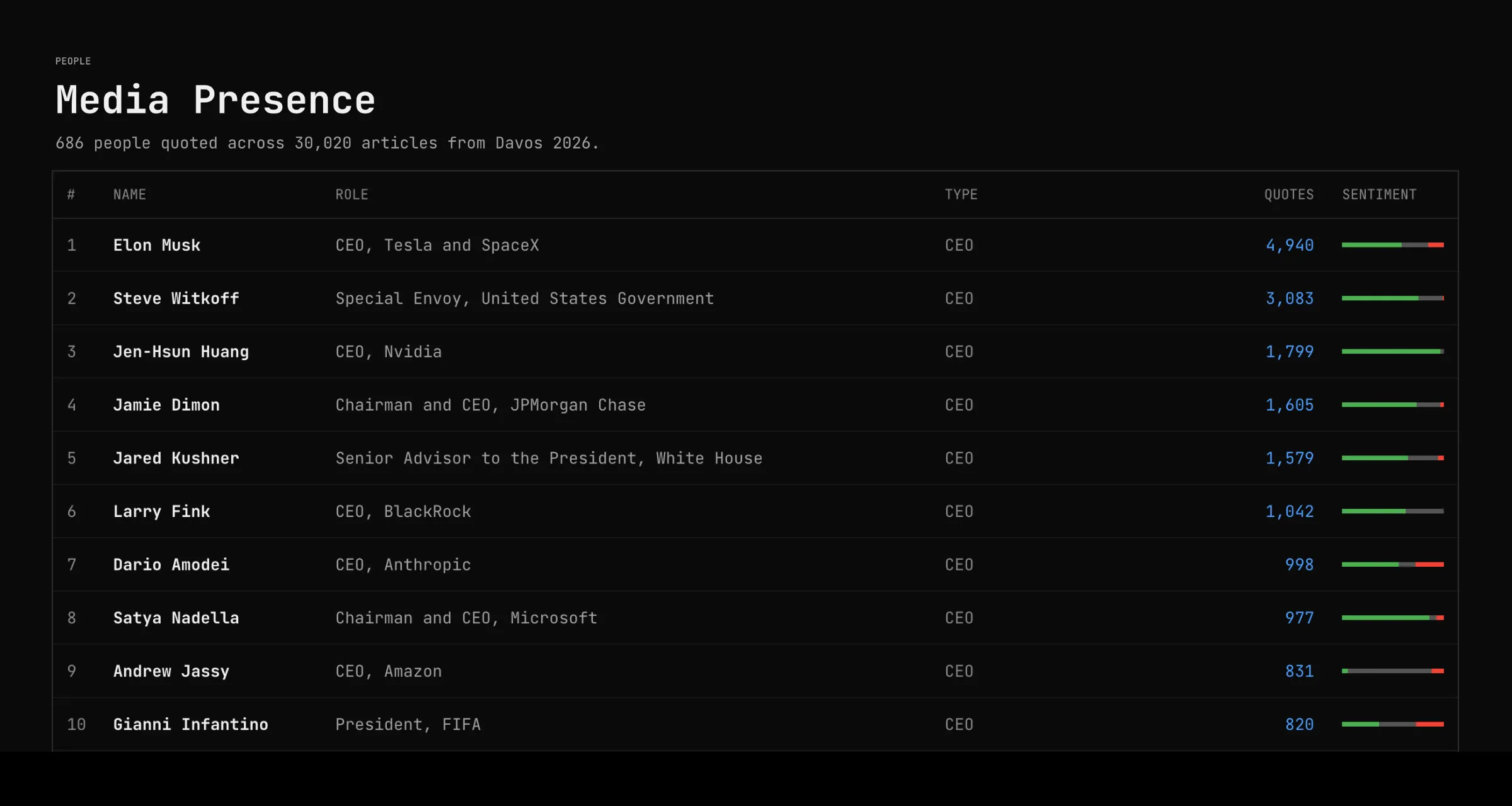
Start with Musk. 443 articles, 4,940 personal quotes, only 53% positive sentiment. Polarising, obviously. But his proximity to Trump means proximity to US AI policy, executive orders, and federal contracts. He's not winning a popularity contest at Davos. He's winning something more valuable: direct access to the decisions that will determine how AI gets deployed by the world's largest economy. You don't need to be liked. You need to be in the room.
Jensen Huang is the opposite play. NVIDIA's CEO had 1,799 quotes with 97% positive sentiment. Nearly perfect. He achieved this by telling a story that had nothing to do with semiconductors and everything to do with national necessity. Every country at Davos wants AI capability. Huang positioned NVIDIA as the company without which that capability doesn't exist. When those countries start signing AI infrastructure deals this year, and they will, Huang won't need to pitch. He's already been pre-sold. A geopolitical argument dressed in a leather jacket.
JPMorgan and BlackRock are the less obvious winners but possibly the most consequential. They don't build AI models. They fund them, value them, and decide which ones get institutional credibility. They took second and third at an AI-dominated conference because every AI company on this list eventually needs their capital or their client relationships. Their presence at Davos wasn't about understanding AI. It was about making sure AI understands who writes the cheques.
Anthropic is the quiet overperformer. 125 articles, 41% positive sentiment, just 4% negative. They outperformed OpenAI on both volume and tone despite having a fraction of the brand recognition. That pattern, elite credibility running ahead of consumer awareness, is exactly right if you believe regulation is coming soon. You want the people drafting AI safety frameworks to know your name and trust your intentions before the public debate even starts.
Which brings us back to OpenAI. 74 articles. 30% positive. 17% negative. The worst sentiment of any major AI player. It's obvious that OpenAI has a consumer product story. A brilliant one. But Davos doesn't reward product stories, it rewards power stories. "We built something hundreds of millions of people love" is a great pitch to users. It doesn't land with the people deciding how AI gets regulated, funded, and deployed at national scale. Those people want to know what you control, who needs you, and what breaks if you're not at the table.
None of this is destiny. OpenAI could build political capital fast. Anthropic's quiet advantage could evaporate. Regulation might stall entirely and consumer adoption could remain the only race that matters.
But here's what isn't uncertain: the people at Davos, the regulators, the capital allocators, the heads of state, will have an outsized role in shaping AI's trajectory. And the coverage tells you clearly which companies already have their attention and which are still outside the room.
Davos 2026 was billed as AI's coronation. It was, in a way. But the companies that won weren't necessarily the ones building the best models. They were the ones that had already figured out that the next 12 months of AI will be shaped less by technology and more by the people who decide where it gets to go.
The scoreboard most people are watching is downloads and benchmarks. The scoreboard that might matter more was at Davos. And most of the AI industry wasn't paying attention.
“I don't think the Davos rankings tell you who's building the best AI. But I think they tell you something more important: who's building the political capital to shape what happens next.”
Ben Guerin
“You don't need to be liked. You need to be in the room.”
Ben Guerin
- 30,020 articles analysed across Davos week
- 319,000 attributed quotes extracted
- 9th where OpenAI ranked by coverage
- 97% positive sentiment for Jensen Huang
Questions & answers
Who commanded the most coverage at Davos 2026?
The Musk empire (Tesla, SpaceX, X and xAI) led with 443 articles, ahead of JPMorgan Chase (238), BlackRock (224) and NVIDIA (224).
Where did OpenAI rank?
Ninth, with 74 articles, and the worst sentiment of any major AI player at 30% positive and 17% negative.
How was the analysis done?
Topham Guerin and data partner Omniscan analysed 30,020 articles from 1,346 publications, extracting 319,000 attributed quotes across Davos week.
What is Topham Guerin's conclusion?
That the next 12 months of AI will be shaped less by model benchmarks than by political capital: the regulators, capital allocators and heads of state who decide where AI gets deployed.