Great AI creative still runs on taste. Delivering it takes a new discipline.
AI tools are more powerful than anything creative teams have had before, and less reliable, so great work now takes two things: people with the taste to know what is good, and the operations to deliver it. Ben Guerin, co-founder of Topham Guerin, calls that second discipline “AI ProductionOps”, drawn from how the agency’s creative team works across several AI tools every day.
- Published in
- bjhguerin.com
- By
- Ben Guerin
- Published
- 30 March 2026
- Type
- Opinion
- Topics
-
- artificial intelligence
- creative production
- agency operations
What we argued
- The creative skill hasn’t changed: it still takes people with taste and judgement to tell great work from generic
- Topham Guerin’s creative team uses several AI tools a day, each for what it does best: Kling for video, Gemini for detail, Midjourney for atmosphere
- Ben calls the operational side “AI ProductionOps”, and argues the agencies that build it first will have a significant advantage
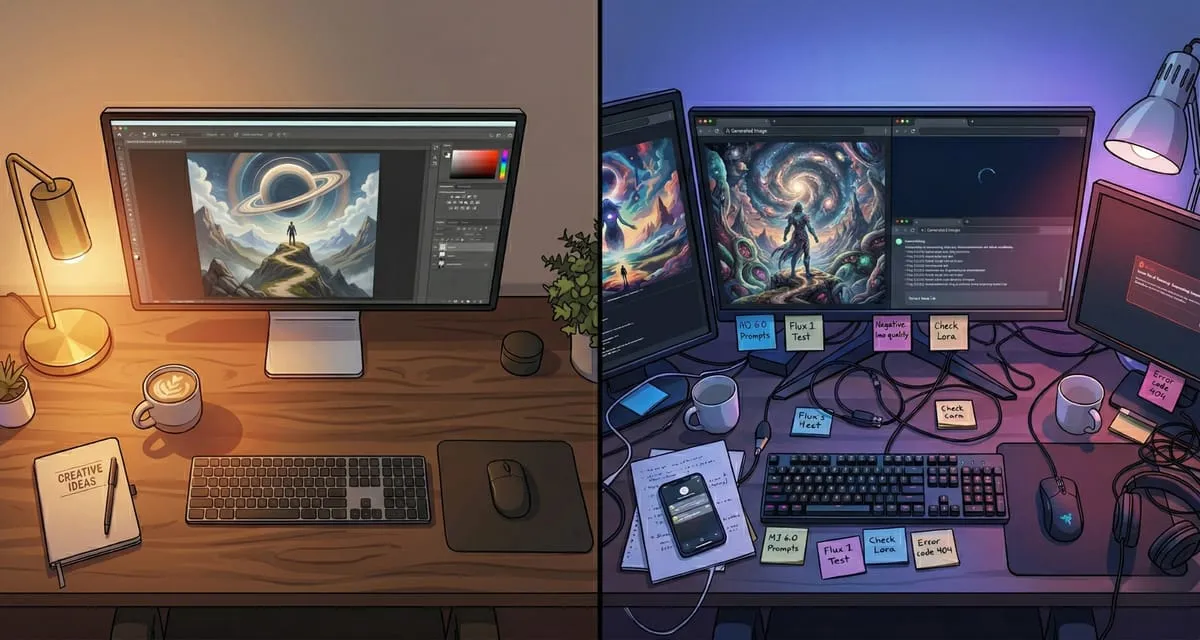
With Photoshop, Illustrator, Premiere Pro and After Effects, the tool just worked. You opened it, it was there, it did the thing. Every time. Reliably. For years. Nobody had a fallback workflow for Photoshop crashing. Because it didn’t.
AI creative tools don’t work like that. They’re more powerful than anything the creative industry has ever had access to. They’re also less reliable than anything the creative industry has ever depended on.
That gap between power and reliability is creating something that, at the risk of sounding like a LinkedIn thought leader, I’ve been calling AI ProductionOps. It’s not a phrase I’m particularly impressed by. But there genuinely isn’t a word for this yet, and the lack of one is part of the problem.
The routing problem. At Topham Guerin, our creative team works across multiple AI tools every day because each tool does something different, and none of them do everything to the standard we need the final outputs to be at.
Kling is our go-to for video, especially when we need frame-to-frame consistency between a start image and an end image. Best in class for that. But it’s often overloaded, and when it’s down, there’s no obvious replacement. You just wait. Try explaining that to a client on a deadline.
Gemini handles detail brilliantly. If you need precision in an image, accurate text rendering, or complex compositions, it’s the strongest option right now. Midjourney is better for atmosphere and scenes, the kind of output where mood matters more than accuracy.
The volatility problem. Every week there’s something new. A model update changes the output quality of a tool you’d finally figured out. A pricing change makes your primary tool uneconomical overnight. The old creative tools were less powerful but reliable. The new ones are more powerful but volatile.
The creative skill hasn’t changed. You still need people with taste, with judgment, with the ability to look at AI output and know immediately whether it’s good enough or whether it’s generic nonsense.
The conversation about AI in creative agencies is almost entirely about output. But almost nobody is talking about the operational layer underneath. The routing decisions, the fallback plans, the consistency management, the tool evaluation cadence. That’s AI ProductionOps. And the agencies that build this discipline first will have a significant advantage over those still treating AI tools like a single-player creative shortcut.
“The creative skill hasn’t changed. You still need people with taste, with judgment, with the ability to look at AI output and know immediately whether it’s good enough or whether it’s generic nonsense.”
Ben Guerin
“At Topham Guerin, our creative team works across multiple AI tools every day because each tool does something different, and none of them do everything to the standard we need the final outputs to be at.”
Ben Guerin
Questions & answers
What is “AI ProductionOps”?
Ben Guerin’s term for the operational layer beneath AI creative output: routing each brief to the right model, maintaining consistency across tools, and building fallbacks for when volatile AI tools fail.
How does Topham Guerin use AI in creative work?
Its creative team works across several AI tools every day, each chosen for what it does best, because none of them does everything to the standard the final work needs.